Is Free Streaming Legal? How to Tell a Safe Site From a Pirate One
How to tell whether a free streaming site is legal — who publishes the stream, what a safe site looks like, the risks of pirate sites, and how Teleora sources its content.

"Free" and "illegal" are not the same thing. Plenty of television, film, radio, books and games are free because the owner wants them to be. The trick is telling that apart from the other kind.
One question decides it
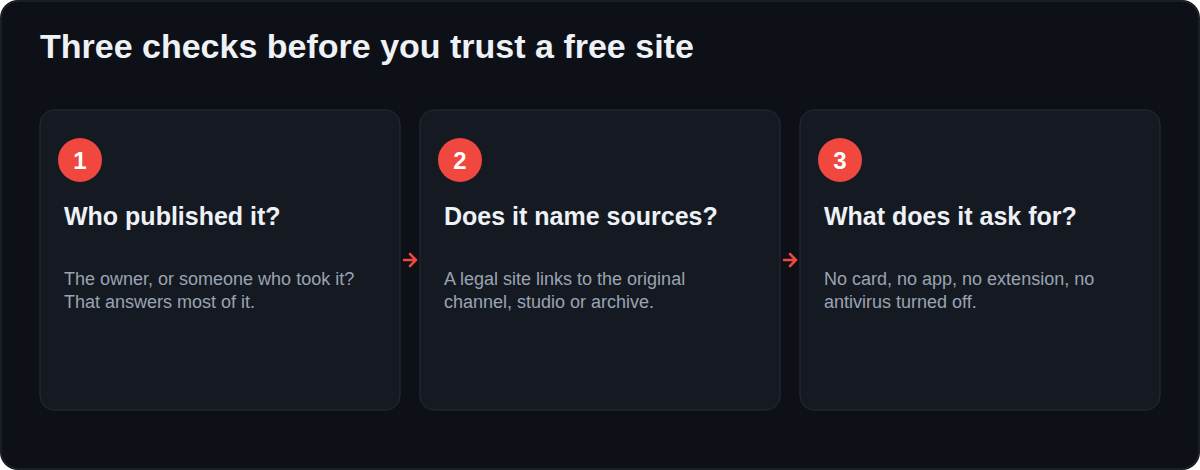
Who published the stream?
- The broadcaster, studio, label or author published it → free and legal.
- Copyright has expired → public domain, free for everyone.
- Someone re-streaming a paid channel or a cinema release → illegal, whatever the site says.
Everything else — the design, the ads, the "HD" badge — tells you nothing.
What a legal free site looks like
- It names its sources. You can see which channel, studio, archive or directory each item comes from, and open the original.
- It hosts nothing it should not. Video and audio play from the owner's own service.
- It has a removal address and a real legal page: terms, privacy, DMCA.
- It asks for nothing. No card "to verify", no app to install, no browser extension, no antivirus turned off.
- It does not fight you. No pop-ups, no redirects, no fake download buttons.
The real risks of pirate sites
Beyond the legal question, those sites make money in unpleasant ways: malicious ads, fake installers, card-skimming "free trials", and mining scripts that heat your phone. The films are also badly encoded and vanish mid-episode. It is a bad deal even when nobody is watching you.
Where the legal free stuff actually is
- Live TV: broadcasters' own open streams and free ad-supported channels.
- Movies: studios uploading complete films to their own channels, plus public-domain cinema.
- Radio: stations streaming themselves, listed in open directories.
- Books and audiobooks: works whose copyright has expired, published by Project Gutenberg and LibriVox.
- Games and archive film: the Internet Archive's library collections.
How Teleora works, in plain words
- Live channels come from open playlists published by the channels themselves; each channel page shows its source.
- Movies come from a hand-checked list of official studio channels, verified partners and public-domain archives — and only full-length films.
- Radio comes from the Radio Browser community directory; the audio streams from each station's own server.
- Books, audiobooks, archive films and games come from Project Gutenberg, LibriVox and the Internet Archive.
- Nothing is hosted on Teleora. There are no ads, no accounts and no payments.
- Anything a rights holder asks about is removed. The DMCA page explains how.

Where the legal free content comes from, in numbers

None of that needs piracy, and none of it needs an account.
What the law actually says, in three sentences
Copyright gives the owner the right to decide who may copy and show their work. If the owner publishes a stream, watching it is exactly what they intended. If someone else re-publishes it without permission, that copy is infringing — and in many countries, including India and most of Europe, knowingly streaming an infringing copy is itself unlawful, not only downloading it.
Six questions that settle almost any case
| Question | Legal free site | Pirate site |
|---|---|---|
| Who uploaded it? | The owner or an archive | Anonymous account |
| Can you open the original? | Yes, linked | No |
| Is there a removal address? | Yes | No |
| Does it ask for a card? | Never | "Just to verify" |
| Does it want software installed? | No | Player, extension, "codec pack" |
| Does the domain change often? | No | Every few weeks |
What you risk on a pirate site, beyond the law
- Malware through ads. Fake "play" buttons that download installers.
- Card theft. "Free trial, card required" pages that exist only to harvest numbers.
- Mining scripts that heat your phone and drain the battery.
- Nothing to complain to. Nobody is responsible when a file is a virus.
How to check Teleora yourself
Open any channel, film, station, book or game page. Each one names its source and links to the original: the broadcaster's playlist entry, the studio's channel, the Radio Browser station, the Project Gutenberg book, the LibriVox recording or the Internet Archive item. If a rights holder wants something removed, the DMCA page explains exactly how, and it comes down.
FAQ
Is it illegal to watch a pirated stream without downloading?
In many countries, streaming an unauthorised copy is itself an infringement, and you also carry the security risk. The practical advice is simpler: there is enough legal free content that you do not need to find out.
Are sites with free movies always illegal?
No. Studios publish complete films free, and public-domain films belong to everyone. What matters is whether the uploader is the owner.
How can I check a source myself?
Open the original item — the channel, the studio's page, the archive record. A legal site links to it; a pirate site cannot.
Does free mean poor quality?
Sometimes the opposite: an official studio upload is usually a clean master, while pirated copies are recompressed several times.
Does Teleora make money from this?
There are no ads and no subscriptions on the site. That is also why nothing needs to be hidden.
Is a VPN needed to watch legal free streams?
No. If a channel is blocked in your country, that is the broadcaster’s licensing decision — using a VPN to get around it breaks their terms.
Can I be fined for watching a pirated stream?
Enforcement usually targets the people running the sites, not individual viewers, but in several countries the viewing itself is unlawful. The security risk is the more immediate one.
Why is this site free if there are no ads?
It costs very little to run: nothing is hosted here, and the players belong to the broadcasters, studios and archives.


