Free University Lectures Online: Yale, MIT and Berkeley
Watch free university lectures online — full courses published by Yale, MIT and Berkeley under Creative Commons, which subjects are covered, and how to study with them.

Some of the best universities in the world film their lectures and publish them for anyone to watch. Not clips — whole courses, in order, free.
Who publishes full courses
- Open Yale Courses — complete introductory courses, filmed in the lecture hall, with syllabi and transcripts.
- MIT OpenCourseWare — course materials for almost every MIT subject, with video for many of them.
- UC Berkeley webcasts — recorded lecture series across the sciences and humanities.
All three release their material under Creative Commons licences, which is what makes them legal to watch, share and use in teaching.
What you can study
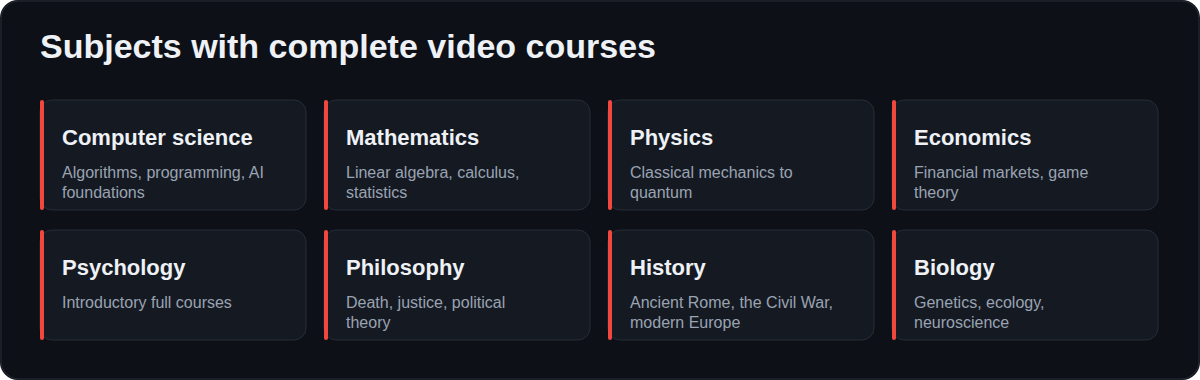
Computer science and programming, linear algebra and calculus, physics, biology and chemistry, economics and finance, psychology, philosophy, political science, history and literature. Introductory courses assume nothing beyond school maths.
How to actually finish a course
- Watch in order. These are lecture series; lecture 7 assumes lecture 6.
- One a day beats six on Sunday. Most are 45–80 minutes.
- Take notes by hand, then read the course's own notes afterwards.
- Do a few problems. MIT and Yale publish problem sets and exams; watching alone teaches less than it feels like.
- Pair with a book. Many set texts for old courses are free classics.
What you do not get
No credit, no certificate, no teacher to ask. This is the lecture, not the degree. For most people that is enough: the point is to understand a subject, not to be examined on it.
Where to find them
They sit in the lectures shelf, where you can filter by university and search by subject or lecturer. Documentary and educational films from national archives are next door in archive films.

Courses worth starting with
| Course | University | Why it is famous |
|---|---|---|
| Introduction to Computer Science | MIT | Teaches thinking, not a language |
| Linear Algebra (Gilbert Strang) | MIT | The clearest maths lectures ever filmed |
| Financial Markets (Robert Shiller) | Yale | A Nobel laureate explaining how money moves |
| Death (Shelly Kagan) | Yale | Philosophy that stays with you |
| Ancient Greek History | Yale | Storytelling with footnotes |
| Introduction to Psychology | Yale | The one everybody finishes |
| Physics: Classical Mechanics | MIT | Blackboard physics done right |
| Structure and Interpretation of Computer Programs | MIT | Old, and still the deepest CS course online |
Free courses compared with paid platforms
| Open lectures (here) | Paid MOOC | University degree | |
|---|---|---|---|
| Cost | Free | Monthly or per course | Very high |
| Material | Real lectures, notes, problem sets | Edited videos, quizzes | Everything, plus teaching |
| Certificate | None | Usually paid | Degree |
| Deadlines | None | Some | Yes |
| Best for | Understanding a subject | A certificate for a CV | A career requirement |
A realistic study plan
- Two lectures a week, not ten. Nobody finishes ten.
- Watch, then write the one idea you would explain to a friend. If you cannot, watch it again.
- Do two problems from each problem set. Not the whole set — two.
- Pair the course with a free book. Many set texts are in the library already.
- Say it out loud. Explaining a lecture to nobody is the cheapest test of whether you understood it.
Who these are actually for
School students who want to see what a subject looks like at university. Working people filling a gap they were never taught. Teachers borrowing explanations. Retired people who finally have the time. No enrolment, no age limit, no tuition.
FAQ
Are these lectures free and legal?
Yes. Yale, MIT and Berkeley publish them under Creative Commons licences, which allow free viewing and sharing.
Do I get a certificate?
No. These are recordings of real courses, not enrolments. There is no credit or certificate.
Do I need to sign up?
No account, no payment, nothing to install.
Which subjects are best covered?
Computer science, mathematics, physics, economics, psychology, philosophy and history have the most complete video courses.
Can I download the lectures?
Yes, in most cases, from the Internet Archive item page, along with the course materials.
Are the courses complete or just samples?
Complete: full lecture series in order, usually 20–40 sessions, with the course’s own notes and problem sets available from the university.
Are subtitles available?
Many courses include transcripts, and players can show captions where the university published them.
Can teachers reuse these in class?
Yes — they are Creative Commons licensed. Follow the licence on each course: attribution, non-commercial and share-alike in most cases.


